Forestry and Wood Products
Capital Flows in Oregon’s Wood and Forestry industry
Oregon’s forests powered a booming wood products industry that shaped the state’s economy and created vibrant rural communities for much of the 20th century. Logging towns thrived and generations of Oregonians earned their livelihoods in sawmills, plywood plants, and lumber yards. Over time, however, environmental regulations, shifts in federal land management, and global market pressures reduced harvest volumes and shuttered mills. These changes displaced thousands of workers and left many rural communities without viable economic alternatives. Today, Oregon is redefining the role of the forestry and wood products industry with innovations in mass timber and other wood and forest technological advances.
The Industry at Large
In recent decades, the Forestry and Wood Products industry has stabilized and even seen some growth. Albeit, much of the industry has shifted from resource extraction to manufactured wood products. As seen in Figure 1, the industry’s gross domestic product (GDP) across the state rose from $4.6 billion in 2013 to $8.2 billion in 2023 (nominal growth). Accounting for inflation, this indicates a 50 percent growth in real GDP. This is roughly in line with GDP growth across the state. The sector’s contribution, as a share of state GDP, has been fairly stable at about 2.5 percent of total GDP since 2014. Employment in the industry has only risen by 9 percent in the last decade, indicating that the productivity in the industry has improved substantially.
Is the local industry growing faster than the national industry?
Yes. As seen in Figure 2 GDP growth in the Oregon Forestry industry has stayed roughly in line with national GDP growth in the industry. In the Wood Products industry, the local industry GDP grew by 82 percent in the last decade, outpacing the national growth in the industry cluster (58 percent GDP growth).
Is Oregon’s Wood Product industry more productive than the nation?1
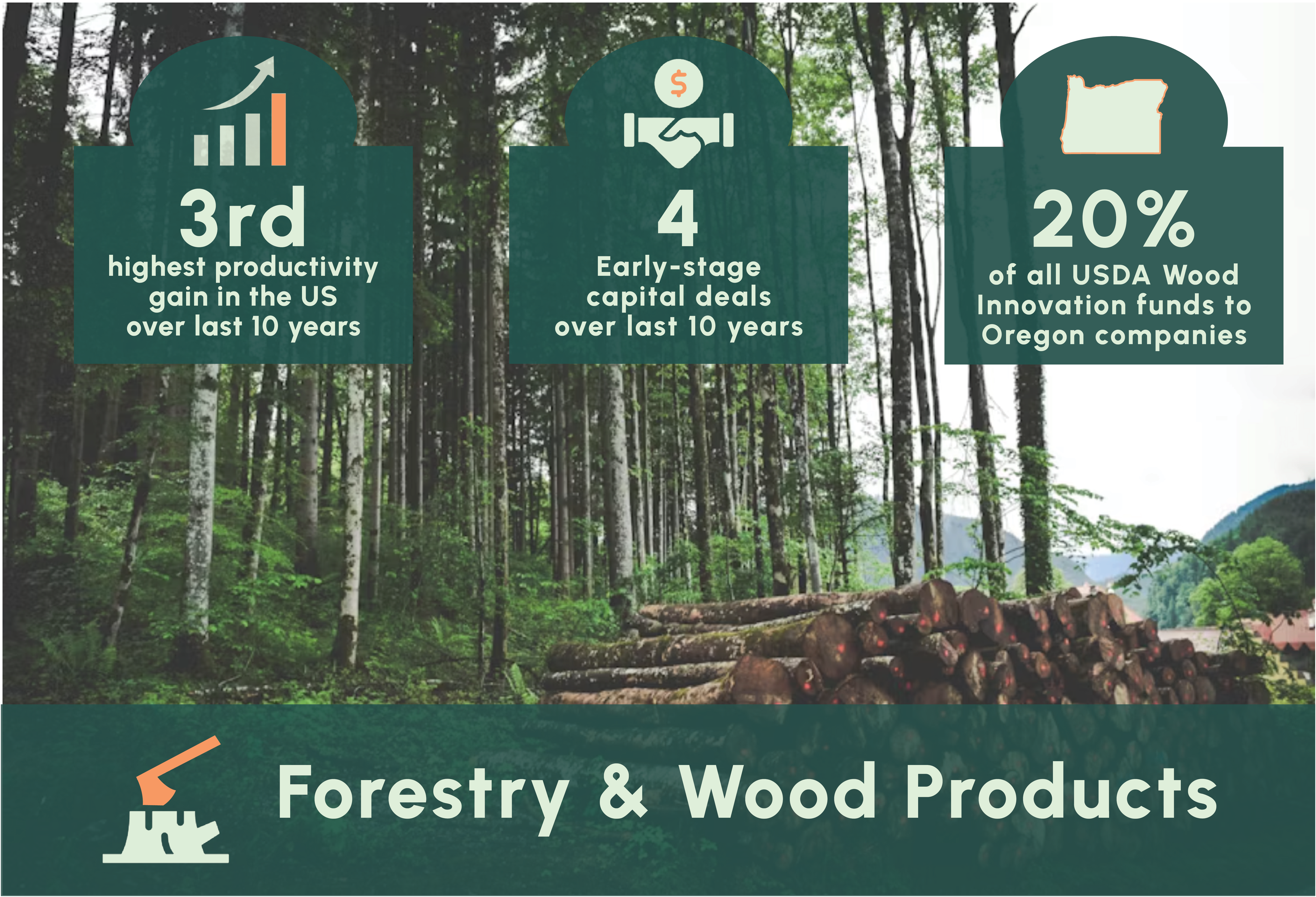
Yes. As of 2023, Oregon had the 10th most productive wood product industries in the country. This is in contrast to 2013 when it ranked 27 out of 50 (see Figure 3). Oregon has seen the third largest gain in productivity of all states in this industry in the last 10 years.
Is Oregon’s Wood Product industry outsized relative to our population?
Yes. Oregon accounts for 1.3 percent of the nation’s population but contributes to 4.3 percent of the nation’s Wood Products GDP (see Figure 4).
Today, a handful of large and well-capitalized companies (some rooted in Oregon, others headquartered elsewhere) drive the state’s forestry and wood products sector. Small sawmills continue to close and startup activity is minimal. The sawmills that do remain in operation have largely switched to automation and do not employ as many workers as the mills of yesteryear.
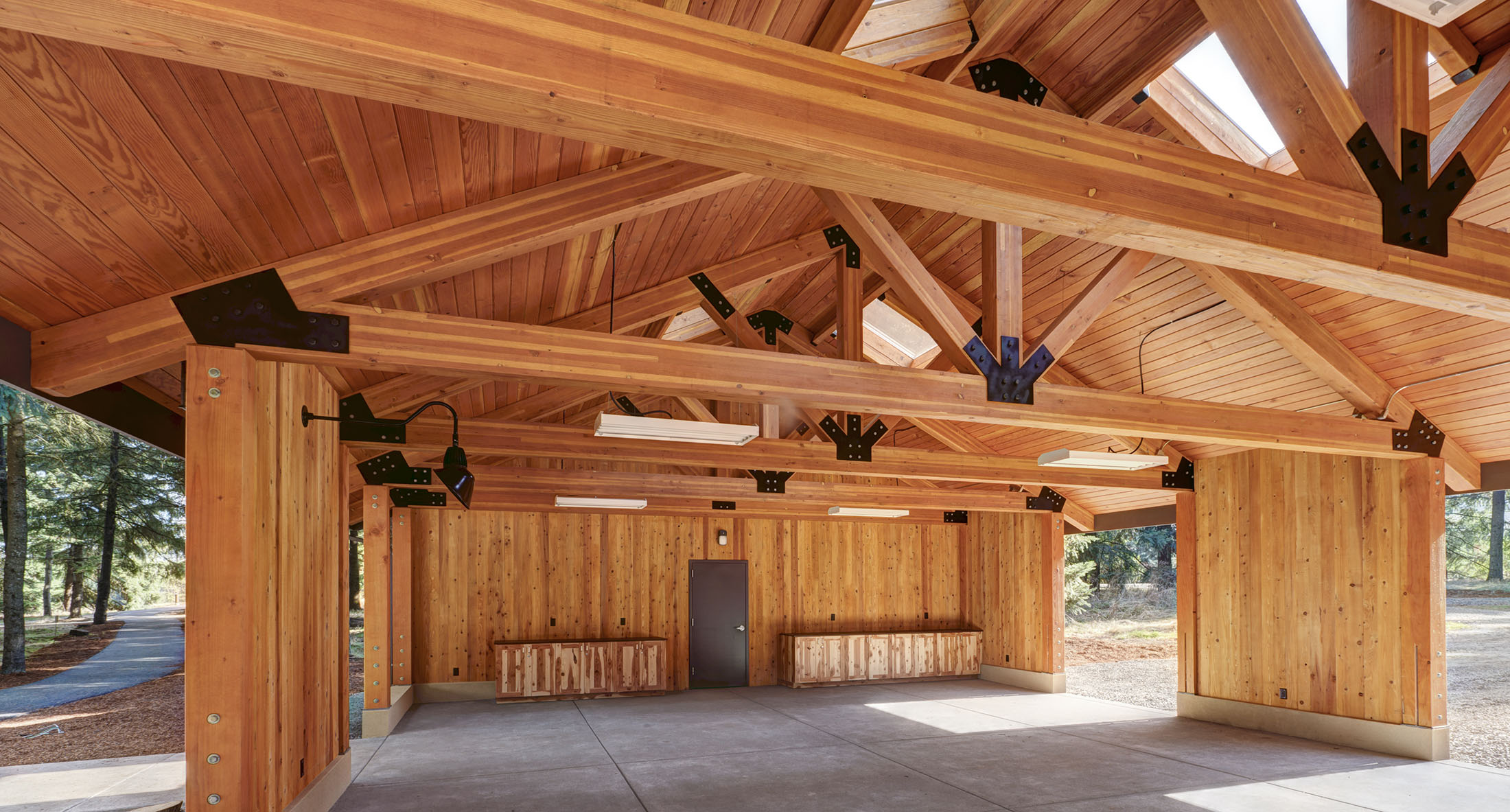
To reignite the role of timber in Oregon, the state is investing in the future of wood products and attempting to emerge as a national leader in mass timber innovation. The Mass Timber Coalition, anchored by the University of Oregon and Oregon State University, pushes the boundaries of engineered wood products, digital fabrication, and low-carbon construction. While mass timber has grown rapidly over the last decade it still only represents a small share of the total forestry and wood product environment, with relatively few entrepreneurs able to convert that momentum into new ventures, leaving a gap between innovation and economic diversification in Oregon’s timber regions.
Role of Capital
We begin our exploration of capital flows in the Forestry and Wood Products industry cluster by investigating dilutive capital – a capital type available at all stages of business development.
Dilutive capital is generally relevant across business stages and maturity across most industries including, to some extent, industries in the Forestry and Wood Products cluster. Early stage companies rely on Seed, Angel and Venture Capital funding to raise investment dollars and grow their businesses. Mid-stage companies trade their equity for venture and private equity capital. As companies mature, they may consider IPO, mergers and acquisitions, and other forms of buyouts. We rely on Pitchbook data to observe the dilutive capital activity in this cluster.
Takeaway
Pitchbook data shows only a handful of equity deals completed in the Forestry and Wood Products industry cluster in the last decade in Oregon. Additionally, it indicates a steady presence of grant and debt capital deals.
Despite hearing interviews discuss several new ventures geared towards wood product innovation, Pitchbook data indicates that early stage capitalization has been low in the state (see Figure 5). Since 2015, there has been only one Seed capital deal in Oregon, one Late Stage VC deal and a couple of Pre-Seed capital deals in this industry cluster. For more mature companies in the cluster, there have been a handful of Buyouts happening in the last decade. Several deals recorded in Pitchbook do not capture the dollar amounts associated with the deals making it difficult to capture the total investment dollars injected into this industry.
The lack of deals for early stage ventures in this industry cluster could be interpreted in several ways. One possibility is that there is a capital gap here: companies with solid business plans are looking for an injection of capital to scale up production, however they are unable to connect to sources of early stage capital. Alternatively, it is possible that early stage companies in this industry cluster are not looking for dilutive capital or are looking for capital but are not seen as viable investments by capital providers. Additional engagement with industry experts, beyond the scope of this project, will be required to determine what is going on with the lack of early stage deals in this industry cluster.
Statewide Pitchbook Analysis
Dive into pitchbook data for all industries in the state here!
We did confirm that many of the new ventures we heard about in our interviews with industry specialists in the sector appear to be expansions of well capitalized local, national, and even international companies attempting to expand into new market niches within the industry cluster. These capital flows and reallocation internal to large companies will not be captured by Pitchbook and capital availability is unlikely to be a key challenge for these ventures.
Source: PitchBook Data (2015-2025 YTD)
Source: PitchBook Data (2015-2025 YTD)
Takeaway
Industry experts confirmed that grant capital plays a meaningful support role not just in early business stages but also with mid-stage expansions in the Forestry and Wood Products Sector.
Pitchbook data also indicates a large stream of grant dollars being injected into this industry since 2015. In many industries, grant dollars are used at early stages for commercialization and Research and Development (R&D).2 The SBIR/STTR grant program is a research and development grant provided by federal agencies to small businesses across the nation. Wood and Forestry related SBIR grants have supported R&D in topics like forest biomass based construction materials, paper packaging from forestry waste and resins from hardwood biomass.
While the total number of SBIR/STTR grants in this industry cluster has been modest –just four awards since 2014 totaling under $1 million —- Oregon has still performed well in attracting federal dollars. Since 2020, the state has secured the fifth-highest total of forestry-related SBIR/STTR grants nationwide. On a per-establishment basis, Oregon ranks eighth for grant dollars received, showing that its firms compete effectively when they pursue these opportunities. Although SBIR/STTR funding is not a major mechanism for this cluster at the national level, Oregon’s results point to untapped potential to increase both the volume and value of awards in the future.3
Source: U.S. Small Business Administration (SBA) / U.S. Federal Government (2005-2025 YTD)
Source: U.S. Small Business Administration (SBA) / U.S. Federal Government (2005-2025 YTD)
More Analysis!
For statewide SBIR/STTR analysis, click here!
There are also federal grants that specifically target mid-stage business expansion rather than early stage R&D activities. For instance, the USDA’s Wood Innovation Program, “stimulates, expands, and supports U.S. wood products markets and wood energy markets.” The program matches private capital investments in national focus areas including mass timber, renewal wood energy and sustainable forest management. Oregon based companies have had a fairly consistent rate of applying for these grants and received about 12 percent of total federal dollars disbursed through this program in 2025.
Source: U.S. Department of Agriculture (USDA), Forest Service (2015-2025 YTD)
Source: U.S. Department of Agriculture (USDA), Forest Service (2015-2025 YTD)
Between federal, state and local sources, it is likely that there are additional grants relevant to this industry cluster that are not captured by this analysis. That said, with the large number of legacy industries in the sector, knowledge of access to grant capital may lag in this industry and outreach and technical assistance for companies may help boost capital access.
Source: U.S. Department of Agriculture (USDA), Forest Service (2015-2025 YTD)
Takeaway
Stakeholder interviews stated debt capital and traditional banking are important capital sources for the Forestry and Wood Products Industry cluster. The majority of debt related data are privately held and it is difficult to identify capital flows and gaps based on publicly available sources..
Another key feature of the industry we heard about during our interviews was that many legacy, family-owned businesses do not pursue dilutive capital. Large cash inventories and traditional banking instruments play a key role in this industry. Unfortunately, the public data availability in this space is limited and particularly challenging when attempting to disaggregate by industry.
Loans backed by the U.S. Small Business Administration is a subset of loans that we can observe and have reliable data on. SBA 7A loans allow small businesses to access loans of up to $5 million. Eligibility is partially determined by total sales receipts or number of employees, however the cutoff varies by industry. For the Forestry and Wood Product industry cluster, the eligibility cut off is no more than about $20 million in receipts or 1,250 employees.
Lending activity does seem to be present through SBA 7a loans, but the amount of awarded loans in Oregon varies significantly since 2010 as seen in Figure 13. The majority of these loans come from the Wood Products industry, with very little subscription from Forestry companies. No clear trend is apparent in this data.
Source: U.S. Small Business Administration (SBA) (2010-2025 YTD)
Source: U.S. Small Business Administration (SBA) (2010-2025 YTD)
Without the ability to observe debt deals from other sources, it is impossible to quantify what share of deals or share dollars of debt these data represent. Furthermore, it is unlikely that debt activity in this instrument is representative of the industry cluster. We do not have a reliable way of knowing what share of establishments in this industry meet the eligibility criteria of SBA 7a Loans. It is likely that capital dynamics for larger companies within the industry cluster differ from those that are eligible for and successfully receive SBA 7a loans.
Case Study: Patrick Lumber

Patrick Lumber has over 100 years of experience in Oregon as a company. Historically headquartered in Portland, they recently made organizational shifts to help adapt to modern economic times, which included moving headquarters to Philomath, adopting a shared ownership model, and investing in a niche of high-end lumber market that focuses on species rarely processed on the West Coast—maple, oak, madrone, chinquapin, and ash. As part of the move to Philomoth, Patrick Lumber acquired the Mary’s Lumber plant to invest in sorting, drying, and edging capabilities, and is now building a dedicated hardwood mill to diversify beyond its traditional softwood sales and reduce reliance on Canadian suppliers.
What was the capital story that propelled their growth?
Patrick Lumber has been fueled by a mix of self-financing, traditional loan capital, and strategic (non-dilutive) public grant funding. In 2020, stable profitability positioned Patrick Lumber to acquire additional acreage with cash and to launch a small-scale hardwood milling operation. Since then, they have secured two USDA Wood Products grants, totaling $2 million, to accelerate the new mill’s development. In addition, they received $100,000 of state assistance through Business Oregon’s Governor’s Strategic Business Plan, which provided forgivable loans tied to job creation (stipulated with providing at least 10 new positions). Patrick Lumber also leveraged Commerce Bank for equipment and property financing. Patrick Lumber’s capital journey highlights the value of persistence and diversification in funding sources. The first federal grant application was time-intensive and costly as it relied heavily on grant writing expertise from a contractor. While the initial grant application was unsuccessful, perseverance paid off when a second-round opportunity arose and was awarded to the company. Additional grants—such as an Energy Trust-supported equipment award—were evaluated for cost and compliance burdens, with the company declining some to focus resources on core expansion goals. Says Patrick Lumber CFO and President, Natalie Heacock, “I thought that getting a grant would include a bunch of strings attached, but I now realize that is not the case.”
Unlike many legacy lumber businesses, Patrick Lumber has a structured succession and ownership model more akin to a professional services firm: twelve current owners buy-in over time, providing periodic capital infusions tied to profitability. This model has helped them avoid the pitfalls of generational turnover and ensured ongoing reinvestment capacity.
For Patrick Lumber, the lesson is clear: capital is out there, but success depends on knowing where to look, building strong lender and agency relationships, and aligning funding with strategic growth opportunities. Their hardwood mill, centered on underutilized Oregon species, aims to open new markets, strengthen supply chain resilience, and sustain the company’s role as a high-value wood products innovator in the Willamette Valley.
References
Bureau of Economic Analysis (BEA). 2013-2023. “Gross Domestic Product (GDP) by County.” 2013-2023. https://www.bea.gov/data/gdp/gdp-county-metro-and-other-areas.
PitchBook Data, Inc. 2015-2025 YTD. “PitchBook Private Capital Markets Database.” 2015-2025 YTD. https://pitchbook.com. Accessed August 20, 2025.
U.S. Bureau of Labor Statistics (BLS). 2024. “Quarterly Census of Employment and Wages (QCEW).” https://www.bls.gov/cew/.
U.S. Census Bureau. 2024. “American Community Survey (ACS) 1-Year Estimates.” https://www.census.gov/programs-surveys/acs/.
U.S. Department of Agriculture (USDA), Forest Service. 2015-2025 YTD. “U.s. Forest Service Wood Innovations Grant Program.” 2015-2025 YTD. https://www.fs.usda.gov/science-technology/energy-forest-products/wood-innovation/grants.
U.S. Small Business Administration (SBA). 2010-2025 YTD. “Small Business Administration (SBA) 7(a) Loan Program.” 2010-2025 YTD. https://data.sba.gov/dataset/7-a-504-foia.
U.S. Small Business Administration (SBA) / U.S. Federal Government. 2005-2025 YTD. “Small Business Innovation Research (SBIR) and Small Business Technology Transfer (STTR) Programs.” 2005-2025 YTD. https://www.sbir.gov/awards.
Footnotes
Comparison of the Forestry industry across states is harder due to data comparability issues.↩︎
Pitchbook does not capture all grant activity and does not record the exact source and funding mechanisms for the grant dollars.↩︎
SBIR/STTR data do not identify the industry of the companies receiving the grants. We identify Forestry and Wood Product related grants by only considering grants provided by the USDA or the EPA and using the grant description to identify topic areas.↩︎