High Tech
Capital Flows in Oregon’s High Tech industry
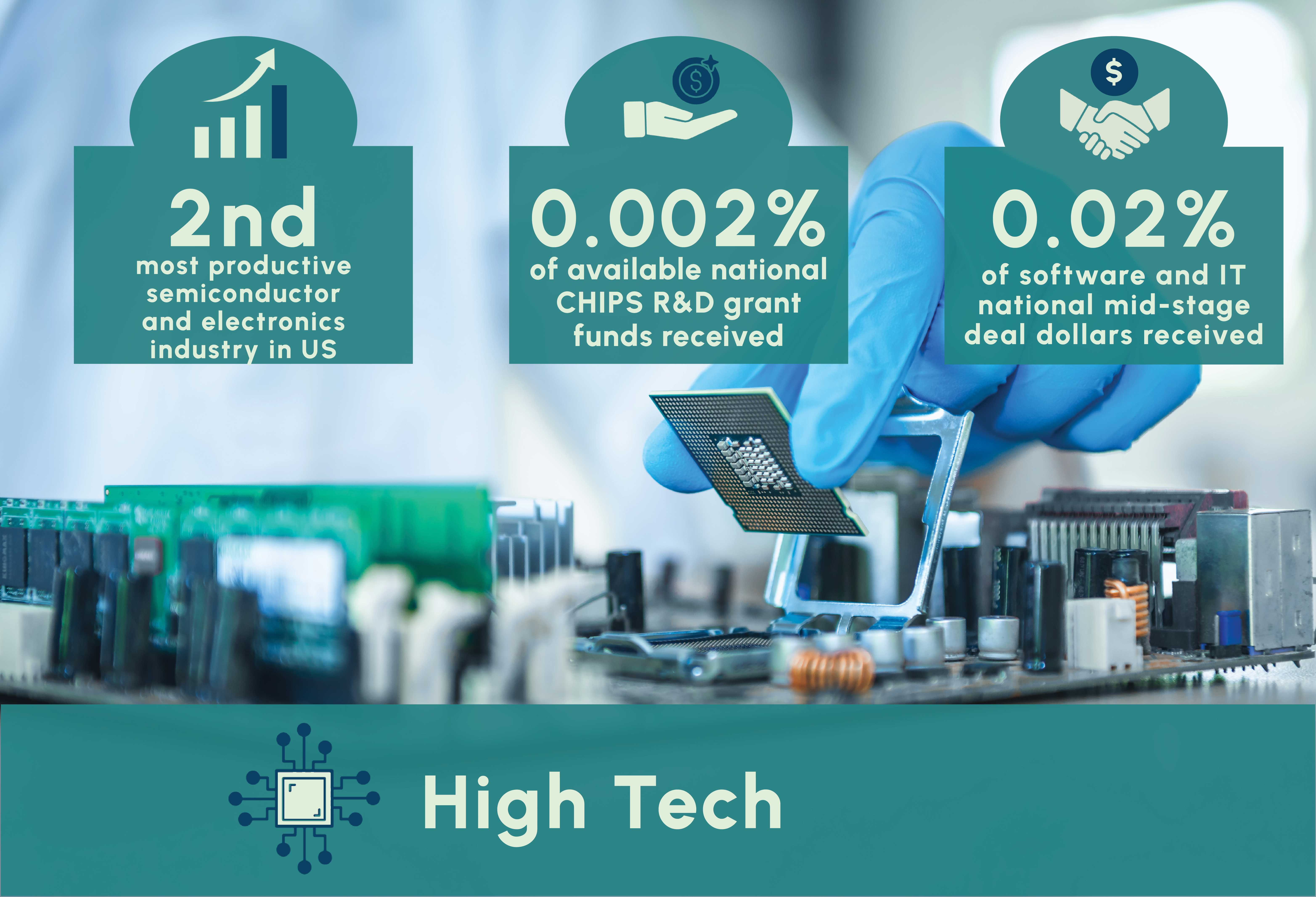
Oregon’s high tech industry has long been anchored by the “Silicon Forest,” a concentration of semiconductor manufacturing, electronic component suppliers, and engineering talent that took root in Washington County starting in the 1980s. This cluster comprises two important categories: Semiconductors and Electronics, and Software and Information Technology. The Semiconductors and Electronics category includes manufacturing companies in semiconductors, computer equipment, communications equipment, aeronautic components, electrical appliances, and navigational instruments. The Software and IT category includes companies involved in information technology infrastructure, software development services, and computer system design services.
Over the last 40 years, the high tech industry has evolved into one of the state’s most important traded sectors, generating high wages, R&D investment, and global visibility. While the industry leaned toward software in the 2000s and 2010s, today Oregon is seeing a reversal as hardware returns to focus, fueled by advancements in AI, robotics, and energy systems. Generally speaking, Oregon’s Semiconductors and Electronics sector is a mature, capital-intensive industry with high barriers to entry, slower turnover, and growth driven primarily by reinvestment and large-scale infrastructure rather than new firm formation. In contrast, the state’s Software and IT sector is fast-growing and innovation-driven, characterized by lower capital requirements, rapid scalability, and continuous entry of new firms.
Unlike software ventures, Semiconductors and Electronics manufacturing companies require significant up-front capital for labs, equipment and long R&D timelines. Oregon’s legacy semiconductor base and pool of engineering talent provide a unique competitive edge, but recent challenges have tempered the pace of growth. Stakeholders in the entrepreneurial ecosystem described Oregon as having a strong reputation for enabling startups, but limited capacity to retain them as they scale. Many firms that reach mid- or large-scale stages relocate in search of deeper capital markets and a broader employment base to support continued expansion.
Takeaway
Stakeholders describe Oregon as strong in startup formation but weak in scaling capacity as many firms relocate out of state to access deeper capital and talent pools.

The Industry at Large
This section dives into the attributes of both the Semiconductors and Electronics subindustry, and Software and Information Technology subindustry. While there is overlap, these two subindustries play unique roles in both the national and state economy and have distinctive capital landscapes and needs.
Semiconductors and Electronics in Oregon has a high concentration of firms relative to the nation and is pivotal to the state’s economy. This subindustry accounted for nearly 10% of state GDP in 2023, contributing $31.3 billion. The industry is fairly mature at this stage and while it has nominally grown by over $6 billion in the last 10 years, the growth rate itself is modest. The subindustry’s share of state GDP has also reduced in recent years, from 13.8% in 2013 to 9.8% in 2023, which is still much higher than the industry’s 1.3% share of national GDP. Although this subindustry makes up a significant portion of the state GDP, the majority of this GDP comes from mature and legacy companies whose capital actions are not observable in the available data. And despite making a concerted effort statewide (Senate Bill 4, known as the Oregon CHIPS Act allocated up to $240 million to enhance Oregon’s competitiveness to attract federal CHIPS funding), Oregon has received only one R&D CHIPS grant for $250,000, representing just 0.002% of the total $13 billion CHIPS R&D funds available nationally. Oregon received 5% (about $2 billion) of the total CHIPS Act manufacturing awards disbursed nationally ($39 billion total).
Software and Information Technology in Oregon grew its GDP by 163% since 2013, faster than the national growth rate of 138%. The sector’s share of Oregon’s total GDP rose from 1.8% to 2.6%, reaching $8.3 billion in 2023. Although Oregon’s share of state GDP remains below the subindustry’s 3.5% share of national GDP, this growth highlights the sector’s rising significance in both the state and national economies. While the general capital trends in this subindustry in Oregon match the larger national trends, Oregon shows an undersized share of the total national capital investment. For example, in 2024, Oregon accounted for only 0.8% of the nation’s deals completed at the mid-stage level (33 of the 3,973 deals) and just 0.02% of the national investment dollars ($246 million in Oregon out of $104 billion nationally).
Takeaway
About 5% of CHIPS manufacturing awards went to Oregon, primarily to mature, well-capitalized firms.
Generally speaking in Oregon, Software and Information Technology is a fast-growing, innovation-driven sector characterized by comparatively low capital requirements, rapid scalability, and continuous market entry by new firms. In contrast, Semiconductors and Electronics is a mature, capital-intensive industry with high barriers to entry, slower turnover, and growth driven primarily by reinvestment and large-scale infrastructure more so than new firm formation.
Is Oregon’s High Tech Industry Cluster Growing Faster than the Nation?
Semiconductors and Electronics
No. The Semiconductors and Electronics subindustry growth lagged slightly behind national trends in recent years. Indexed to 2013, the difference between Oregon’s and the national subindustry growth is roughly 8 percentage points. This difference would widen if the growth analysis was indexed to 2017, as the lag between Oregon and the nation was especially pronounced in these years. This increasing gap in GDP growth is largely tied to Intel, previously the largest employer in the greater Portland region before the most recent layoffs, and results from their loss in market share dominance to other competing national and international firms during this time period.
Software and Information Technology
Yes. The Software and IT subindustry has seen significant national growth in the last decade, and Oregon’s subindustry has even outpaced these national trends. Where the national subindustry grew 138% since 2013, Oregon grew 163%, as shown in Figure 2.
Is Oregon’s High Tech Industry More Productive than the Nation?
Semiconductors and Electronics
Yes. In 2014, Oregon had the nation’s most productive Semiconductors and Electronics subindustry. In 2023, only productivity in California had surpassed Oregon (see Figure 3).
Software and Information Technology
Yes. Between 2014 and 2023, Oregon’s Software and Information Technology subindustry grew from the 15th most productive to the 6th most productive state in the nation, accounting for the fourth largest productivity gain across all states.
Is Oregon’s High Tech Industry Cluster Outsized Relative to Our Population?
Semiconductors and Electronics
Yes. The Semiconductors and Electronics subindustry is significantly outsized relative to the population in Oregon. In 2023, Oregon accounted for 1.3% of the national population but 8.2% of national GDP in this subindustry (see Figure 5).
Software and IT
No. Despite having higher than average GDP growth and productivity gain in the past decade, the Software and IT industry is still relatively undersized in Oregon. In 2023, Oregon accounted for 1.3% of the national population, but 0.9% of national GDP in this subindustry, as shown in Figure 6.
Role of Capital
Semiconductorsand Electronics
The semiconductors and electronics subindustry cluster is comparatively capital intensive as creating and scaling products often requires specialized tools, research and development, and raw materials. The CHIPS Act, announced in 2022, was the largest federal investment in the high tech field, particularly related to the Semiconductors and Electronics subindustry. The Research and Development (R&D) CHIPS Act funding is discussed below in the early-stage section, and the remainder of available CHIPS Act funding is discussed in the late-stage section. There is uncertainty about the amount of CHIPS funds announced versus what will actually become available for US companies due to changes in federal policy during this time.
Early-Stage
Research and Development (R&D) grants can be important in this space, but are also difficult to track. The Semiconductor Industry Association tracks some R&D funding that has been authorized through the federal CHIPS Act in 2022. The CHIPS Act authorized up to $13 billion over 5 years in semiconductor research and development to be disbursed through both the Department of Commerce ($11 billion) and the Department of Defense ($2 billion). Of this, just one quarter million dollar grant went to an Oregon based company, representing less than 0.002% of available R&D grant funds.
SBIR and STTR grants also help support R&D in Semiconductors and Electronics. As shown in Figure 7, in 2025, none of the 20 active SBIR/STTR awards in Robotics went to Oregon companies. Two Oregon companies, LuxNour Technologies Inc and QUANTUM METROLOGY, did successfully win Phase 1 awards for Semiconductors. Oregon received no Phase 2 funding in 2025. Since 2020, Oregon has ranked 11th in terms of the number of SBIR/STTR grants it has received for semiconductors and electronics research.
Source: U.S. Small Business Administration (SBA) / U.S. Federal Government (2005-2025 YTD)
Source: U.S. Small Business Administration (SBA) / U.S. Federal Government (2005-2025 YTD)
Beyond grants, dilutive capital is a key source of funding in the Semiconductors and Electronics subindustry. While early-stage investment activity is present in this subindustry, it remains relatively modest. Reported funding for university spin-offs, pre-seed ventures, and accelerator-stage companies suggests that capital is available for innovators, but it is difficult to assess whether the supply of capital matches demand. According to PitchBook data (Figure 9), there have been 37 early-stage deals involving 21 companies over the past decade, but roughly half of these deals lack reported dollar amounts, limiting our ability to evaluate total investment volume. Two university spin-offs from Oregon State University and Portland State University completed recorded deals in 2015 and 2016, but no new deals are observed since and the number of university spin off deals across the nation has also reduced in recent years.
There is a steady flow (albeit, low in count) of Pre-seed, Accelerator and Incubator deals reported in the last decade, indicating some level of capital support for new ventures, although Angel and Seed rounds have been relatively few. At the national level, Pre-Seed, Accelerators and Incubator deals represent the largest share of early stage deals. Deal counts in Oregon and across the nation are low enough to make interpretations of trends challenging.
Source: PitchBook Data (2015-2025 YTDa)
Source: PitchBook Data (2015-2025 YTDa)
Source: PitchBook Data (2015-2025 YTDb)
Source: PitchBook Data (2015-2025 YTDb)
Mid-Stage
A similar landscape as early-stage equity is observed for mid-stage equity deals in the Semiconductors and Electronics subindustry. Since 2015, 27 companies successfully completed a total of 59 deals in Oregon (see Figure 13). Many of these companies raised Seed funding in prior years, which shows the continuation and growth of many startups over the last decade. The median capital infusion per equity deal was about $13 million during this period and no clear trends in deal size or type are readily apparent. The concentration of high tech companies in Oregon indicates that some ventures are well capitalized. However, this is not sufficient information to evaluate mismatches in capital supply and demand.
Nationally, the number of venture capital deals in this subindustry is not high relative to what is observed in the software subindustry. Based on the available Pitchbook data for mid-stage grant capital, there also appears to be a significant share of grant capital in this subindustry, though decreasing since about 2022 in regards to deal count and amount, both nationally and in Oregon.1
Source: PitchBook Data (2015-2025 YTDa)
Source: PitchBook Data (2015-2025 YTDa)
Source: PitchBook Data (2015-2025 YTDb)
Source: PitchBook Data (2015-2025 YTDb)
Late-Stage
Among late-stage deals in the Semiconductors and Electronics subindustry, some noticeable findings are the lack of observable debt deals and the prevalence of exit deals. Pitchbook captures 86 late-stage deals across 54 companies in the last decade. Of these, roughly a third of the deals were companies being acquired through Mergers & Acquisitions or Buyouts. There are also only a handful of debt deals captured by Pitchbook during this time period.
The Semiconductors and Electronics industry in Oregon is fairly mature at this stage with legacy companies, like Intel, accounting for the majority of employment (over 20,000 employees) and value add (a reported $16.8 billion of economic impact in Oregon based on 2023 data). Pitchbook data does not reliably capture the capital activities of Intel and other mature companies.
Despite a concerted state level strategy to attract Federal CHIPS Act dollars into Oregon, the state has underperformed. Beyond the R&D grants discussed above, there have only been four announcements of Manufacturing CHIPS awards in Oregon. These account for just over $2 billion dollars out of the $39 billion available for disbursement, an undersized share (5%) relative to the state’s GDP contributions and productivity; most of these awards went to well capitalized and mature companies, which are not the focus of this capital scan.
Source: PitchBook Data (2015-2025 YTDa)
Source: PitchBook Data (2015-2025 YTDa)

Software and Information Technology
Software and Information Technology startups have a robust national capital market in this subindustry and investment has soared in recent decades. This subindustry is known for its high volume of both equity deals and exit deals.
Early-Stage
Grants, such as SBIR and STTR funds, do not play a large part in the early stages for the Software and Information Technology subindustry. The capital costs to set up these companies is often low compared to other industries (particularly compared to Semiconductors and Electronics) and capital infusion in the early stages most often comes from equity deals.
In 2022, there were nearly twice as many early-stage capital deals completed in this subindustry as compared to the average number of deals completed from 2015 through 2020. Oregon saw comparatively fewer deals in 2024 as the national average, but one year alone is not enough to indicate a broader trajectory.
Early-stage deals in the Software and Information Technology subindustry have roughly aligned with national activity. Over the last decade, Angel investing on average accounted for just under 10% of the early stage deals both nationally and in Oregon. Nationally, the median deal amount was $250,000 for Angel investments and $2.2 million for Seed investments, and in Oregon was $220,000 for Angel investments and $2.75 million for Seed investments.
Source: PitchBook Data (2015-2025 YTDa)
Source: PitchBook Data (2015-2025 YTDa)
Source: PitchBook Data (2015-2025 YTDa)
Source: PitchBook Data (2015-2025 YTDb)
Mid-Stage
Like early-stage, mid-stage financing in Software and Information Technology is comparable to national trends. Most mid-stage deals are financed by venture capital, and as companies mature, deal sizes and valuations increase substantially compared to the smaller, lower-valued investments seen in the early-stage rounds, when firms are still young and proving their business models. In 2024, Oregon accounted for only 0.8% of the number of deals completed at this stage (33 of the 3,973 deals) and just 0.02% of the national investment dollars ($246 million in Oregon out of $104,698 million nationally).
Takeaway
Oregon has not grown as much as the nation for mid-stage deals since 2022
Source: PitchBook Data (2015-2025 YTDa)
Source: PitchBook Data (2015-2025 YTDa)
Source: PitchBook Data (2015-2025 YTDb)
Source: PitchBook Data (2015-2025 YTDb)
Late-Stage
Unsurprisingly, market exits are a key strategy for entrepreneurs in the Software and Information Technology subindustry with the vast majority of the late-stage deals concentrated in Mergers & Acquisitions or buyouts. Once again, the growth in this subindustry’s deals roughly align with national trends, suggesting that the capital environment in Oregon is generally similar to the national capital market.
Source: PitchBook Data (2015-2025 YTDa)
Source: PitchBook Data (2015-2025 YTDa)
Case Study: Overwatch Imaging
Overwatch Imaging, based in Hood River, develops advanced airborne imaging systems that combine sensor hardware and AI-enabled software to automate aerial intelligence for uses such as defense, disaster response, and environmental monitoring. Founded in 2016, Overwatch Imaging was led by two co-founders with previous experience in the Columbia Gorge drone and imaging sector. Overwatch Imaging is part of a longer lineage of high-tech spinoffs that trace back decades to firms like Insitu and Cloud Cap, which helped establish Hood River as one of the nation’s most active small-scale aerospace clusters. Overwatch Imaging has grown in Hood River from a small startup in an 1,100 square foot former pediatrics office and expanded into a modern waterfront office building backed by venture capital.
What Was the Capital Story that Propelled Their Growth?
Overwatch Imaging started from the founder’s personal savings, enough to cover about the first 6 months of operations. That startup capital, along with early revenues from pilot contracts, allowed Overwatch Imaging to progress for about three years without any additional outside investors. By 2019, the steady growth performance and a proven customer base attracted an out of state seed investor, recommended by a satisfied Overwatch Imaging client. This seed funding marked a growth inflection point for Overwatch Imagining, enabling the company to acquire additional inventory, hire operational leadership, and move out of a cramped former pediatrics office and into a large newly built waterfront space.
Traditional lending played little role in Overwatch Imaging’s early years. Banks did not offer useful credit availability while the company was starting up and the founders were reluctant to personally guarantee business loans beyond the initial startup capital. Only after reaching roughly $12-13 million in annual sales and with significant cash reserves could the company secure meaningful venture-style debt.
Initially, Overwatch Imaging described feeling too small to pursue federal grant programs such as SBIR. The process, they found, was slow, cumbersome, and underfunded; too costly a distraction from day-to-day operations for a lean startup. The company pivoted strategies and secured a round of venture capital funding in 2021. Having secured this funding, the company began applying for SBIR grants, treating them less as catalytic capital and more as a way to build relationships with research and government partners. As the founder put it, “you have to be big and stable just to survive the SBIR process.”
Overwatch Imaging’s stability became critical when the company faced a crossroads to growth. The “lumpiness” of its business model (selling costly and complex systems with only a few crucial sales per year) made cash flow unpredictable and traditional financing unattainable. At the end of 2021, Overwatch Imaging began raising its Series A round funding, which ultimately provided the liquidity needed to both smooth operations and reshape the company’s trajectory. The new venture investors pushed the company to expand beyond its niche in wildfire-mapping hardware toward larger defense and software markets, repositioning Overwatch Imaging to fit a more conventional venture-growth profile.
References
Bureau of Economic Analysis (BEA). 2013-2023. “Gross Domestic Product (GDP) by County.” 2013-2023. https://www.bea.gov/data/gdp/gdp-county-metro-and-other-areas.
PitchBook Data, Inc. 2015-2025 YTDa. “PitchBook Private Capital Markets Database.” 2015-2025 YTD. https://pitchbook.com. Accessed September 26, 2025.
PitchBook Data, Inc. 2015-2025 YTDb. “PitchBook Private Capital Markets Database.” 2015-2025 YTD. https://pitchbook.com. Accessed October 1, 2025.
U.S. Bureau of Labor Statistics (BLS). 2024. “Quarterly Census of Employment and Wages (QCEW).” https://www.bls.gov/cew/.
U.S. Census Bureau. 2024. “American Community Survey (ACS) 1-Year Estimates.” https://www.census.gov/programs-surveys/acs/.
U.S. Small Business Administration (SBA) / U.S. Federal Government. 2005-2025 YTD. “Small Business Innovation Research (SBIR) and Small Business Technology Transfer (STTR) Programs.” 2005-2025 YTD. https://www.sbir.gov/awards.
Footnotes
Pitchbook is not a comprehensive source for grant capital.↩︎