Food and Beverage Manufacturing
Capital Flows in Oregon’s Food and Beverage Manufacturing industry
Oregon’s food and beverage industry grows from the state’s deep and diverse agricultural heritage. From wheat and hops to wine, beer, dairy, and seafood, the cluster spans farms, processors, and small, as well as globally recognized brands. In the 20th century, the sector was defined by large processors of frozen fruits and vegetables. In the 2000s and 2010s, the growth story shifted to craft brewing, wineries, and natural/organic products. Today, Oregon’s reputation for high-quality, place-based food and drink continues to support export markets and a strong tourism draw.
Oregon is home to multinational food processors with significant capital (Tillamook, Reser’s Fine Foods, Franz Bakery) as well as to thousands of small, often family-owned, food businesses. Many of these smaller firms operate on thin margins and face steep challenges accessing the capital and knowhow needed to scale. Notable successes show what’s possible: Stumptown Coffee grew from a Portland café to a nationally distributed brand before being acquired by Peet’s and Brew Dr. Kombucha scaled into national grocery distribution with private equity support. Yet, for every one of these success stories, dozens of local brands remain stuck at a small scale, celebrated regionally but unable to make that tenfold level of growth needed to break into national distribution.
The Industry at Large
After some strong growth between 2013 and 2017, the nominal GDP growth in Food and Beverage Manufactruing has plateaued in the last 5 years. Across the state, the industry’s gross domestic product (GDP) rose from $2.5 billion in 2013 to $4.2 billion in 2023 (nominal growth). Accounting for inflation, this indicates a 38 percent growth in real GDP. The sector’s contribution as a share of state GDP has fallen from 1.4 percent total GDP to 1.3 percent. Employment in the industry has risen by 17.3 percent in the last decade, indicating a gradual rise in productivity.
Source: Bureau of Economic Analysis (BEA) (2013-2023)
Source: Bureau of Economic Analysis (BEA) (2013-2023)
Is Oregon’s Food and Beverage Industry Growing Faster Than the Nation?
Yes. GDP growth in the Oregon Food and Beverage industry has grown faster than national GDP growth in the industry since 2013.
Is Oregon’s Food and Beverage Industry More Productive Than the Nation?
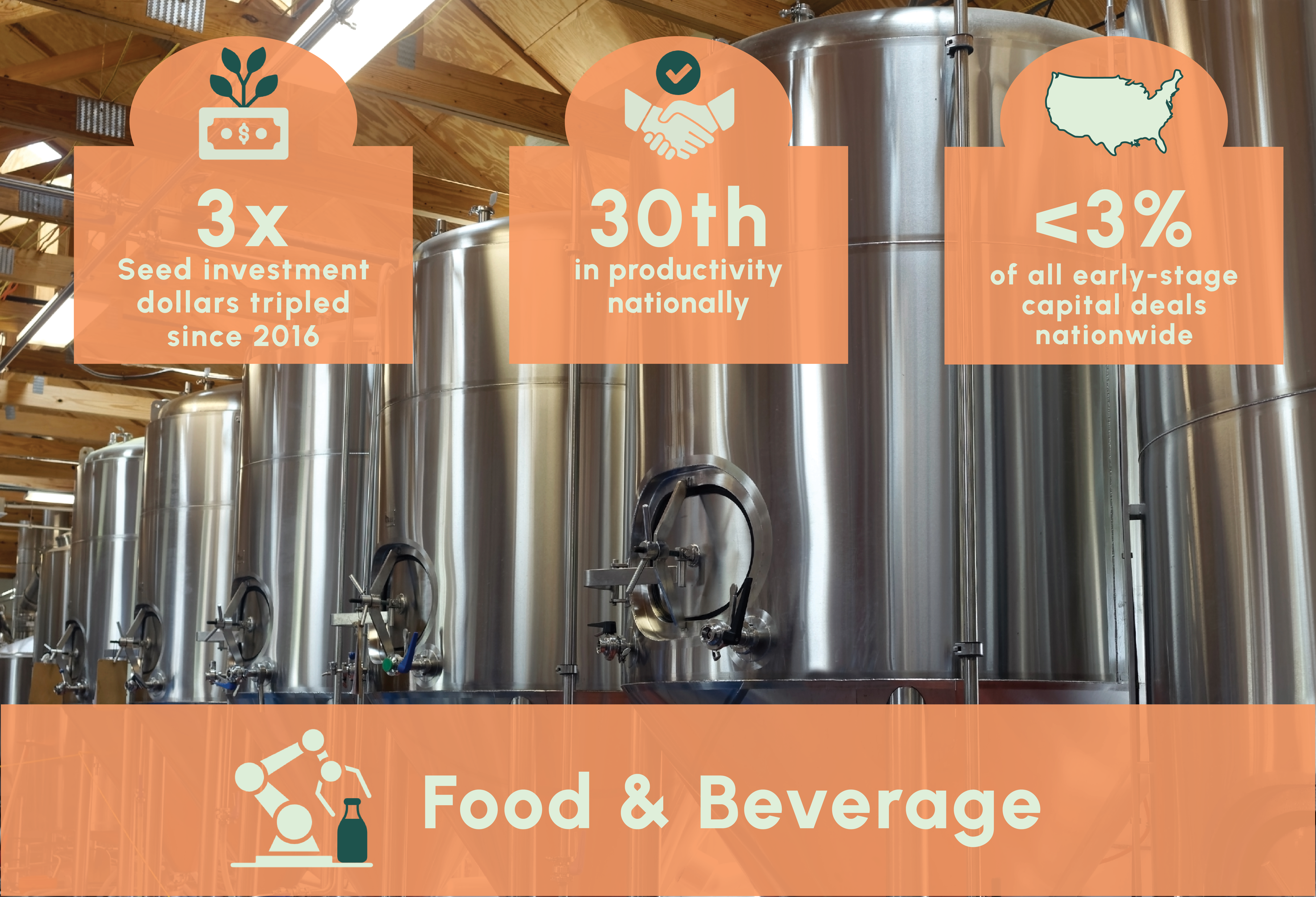
No. As of 2023, Oregon ranked 30th of the 50 states in terms of productivity per employee. This is an improvement from 2013 when it ranked 36th out of 50 states. Oregon saw the twelfth largest gain in productivity of all states in this industry in the last 10 years.
Is Oregon’s Food and Beverage Industry Outsized Relative to Our Population?
No. Oregon accounts for 1.3 percent of the nation’s population and 1.3 percent of the nation’s Food and Beverage GDP.
Role of Capital
Kitchen Entrepreneurs (Startup)
Food and beverage manufacturing businesses often start as ventures run out of family basements, garages and kitchens. Entrepreneurs put a lot of their own money into their business and might ask for financial assistance from friends and families. While this method is known to be common, it is difficult to put a dollar amount to this bootstrapping investment using publicly available data.
Takeaway
Despite total Kickstarter pledged dollars declining since 2015, Oregon still had the fifth largest amount of dollars pledged for food related Kickstarter crowdfunding campaigns in 2023.
Some entrepreneurs may turn to crowdfunding beyond friends and family. Kickstarter campaigns offer one such source of crowdfunding capital. Food related Kickstarter campaigns include food manufacturers as well as main street food service ventures. The number of Food related Kickstarter campaigns and the total number of dollars pledged have both declined over the last 10 years in Oregon.
Source: Inter-university Consortium for Political and Social Research (ICPSR), University of Michigan (2015-2023)
In 2023, 40% of food related Kickstarter campaigns in Oregon were successful in raising their targeted dollar amount, and Oregon had the fifth highest number of dollars pledged compared to other states. While entrepreneurs in Oregon raised a proportionally large share of Kickstarter capital compared to other states, the total dollars pledged is modest ($194,000 across 7 campaigns).
Source: Inter-university Consortium for Political and Social Research (ICPSR), University of Michigan (2015-2023)
Moving to a Commercial Space (Early-Stage)
As businesses scale up in size, entrepreneurs in the food and beverage industry may turn toward dilutive and grant capital to continue their growth. Some businesses may take out loans, however, a lack of collateral and low profitability make traditional loans generally inviable.
Takeaway
There has been a steady flow of early stage equity investments in Oregon’s Food and Beverage Cluster with deals for Pre-Seed companies on the rise.
Businesses at the early stage also turn to dilutive capital sources as they scale production. The number of deals completed for Pre-Seed, Accelerator and Incubator stage companies has grown in recent years. This is an indicator of a strong capital network and capital availability. Oregon cultivates a rich resource network for food and beverage entrepreneurs and the deal activity suggests that this network is serving very early stage businesses well.1
Following these investments at the very early stage comes the capital flow of capital for businesses seeking Seed and Angel investment. The amount of Seed investment dollars has about tripled since 2016 (~$1.5M in 2016 to ~$7M in 2025), while the annual number of total Seed deals has remained relatively consistent (1-3 observable deals per year). The amount of Angel investment dollars has decreased since 2015 (~$1M in 2015 to ~$0.25M in 2025), as well as the annual number of total Angel deals (2-4 observable deals per year before 2020 and closer to 1-3 deals after 2020). The overall early stage capital investment amounts have increased over the last 10 years, bolstered mostly by Seed activity. In 2024, Oregon accounted for less than 3% of all early-stage capital deals nationwide. The state’s distribution of deal types closely mirrors national patterns.
Source: PitchBook Data (2015-2025 YTDa)
Source: PitchBook Data (2015-2025 YTDa)
Source: PitchBook Data (2015-2025 YTDb)
Source: PitchBook Data (2015-2025 YTDb)
Early stage commercialization grants are also available through various public and private sources. Stakeholders mentioned that accessing these grants can be challenging for entrepreneurs due to a combination of factors such as the lack of knowledge of the grants, complicated eligibility requirements, lack of grant writing experience, asymmetry in capital needs, and grant conditions.
Industrial Production (Mid-Stage)
As companies continue expanding production and need additional capital to scale, they turn to larger sources of capital.
Grants may be used for helping move from small to mid scale or to continue to gain efficiencies at the mid stage.2
Activity in mid-stage dilutable capital deals appears higher in the last five years relative to previous activity, primarily driven by later-stage VC deals. Since 2020, later-stage VC deals have accounted for approximately 60% of all mid-stage activity in Oregon, compared to about 40% nationally. Several of these deals over the last 10 years have gone to the same few companies, including Puffworks, Wheyward Spirit and Riff Beverages, showing their ability to access capital as they have matured and grown in Oregon.This is testament to Oregon’s capital ecosystem and its ability to grow with a company. However, limited data restricts further insights into the extent of the demand or supply for more of this capital.
Source: PitchBook Data (2015-2025 YTDa)
Source: PitchBook Data (2015-2025 YTDa)
Source: PitchBook Data (2015-2025 YTDb)
Source: PitchBook Data (2015-2025 YTDb)
Traditional debt usually becomes more accessible for food and beverage manufacturing businesses at later stages. Businesses can rely on non-traditional debt sources such as friends and family, CDFIs, and crowdfunding, but data for these sources was either not available or when available, did not show substantial deal activity in Oregon. While traditional debt may be available at this stage, stakeholder interviews described it as an inaccessible or unviable capital source due to low or negative profit margins often associated with scaling in this industry.
Specific small business loans such as SBA 7a and SBA 504 loans can provide some capital injection at the mid stage. Between the two instruments, SBA 7a loans have significantly higher subscription.3
SBA 7a loans provide up to $5 million for business expenses including working capital, infrastructure improvement, and input costs. SBA 504 loans are disbursed through Certified Development Companies (CDCs) and provide up to $5.5 million for infrastructure investments.
The number and amount of SBA loans provided in Oregon has reduced slightly in recent years. A rise in interest rates across the economy may play a role in reducing the attractiveness of these debt instruments.
Source: U.S. Small Business Administration (SBA) (2010-2025 YTD)
Source: U.S. Small Business Administration (SBA) (2010-2025 YTD)
Exits and National Expansions (Late-Stage)
Oregon’s food and beverage manufacturing industry has seen a consistent level of deal activity for late stage capitalization. A consistent rate of merger and acquisition and buyouts indicate market exits. Many of these deals do not have data available on deal size, which makes analyzing valuation trends difficult. The distribution of late-stage capital deals in Oregon closely aligns with national trends.
Source: PitchBook Data (2015-2025 YTDa)
Source: PitchBook Data (2015-2025 YTDa)
Source: PitchBook Data (2015-2025 YTDb)
Source: PitchBook Data (2015-2025 YTDb)
Case Study: Monkey Brittle

Monkey Brittle, based out of Hood River, started like many small businesses, out of a garage. The small company produces a banana, tree nut, and raisin snack food that children and adults alike report as delicious. The concept for Monkey Brittle started in 2015 and as the loyal fan base grew, and as revenues reached six-figures, the company sought expansion outside of its garage setup. In 2023, Monkey Brittle moved into a 6,000 square foot facility (with room to expand onto a second floor) as a foundation for scaling production and future growth, but faced significant capital expenses associated with scaling their operation.
What Was the Capital Story that Propelled Their Growth?
To grow from the garage into the larger production facility, Monkey Brittle owners relied on a mix of personal savings, help from friends and family, and a Business Oregon infrastructure grant of $60,000 that funded a commercial dehydrator, refrigeration, and food safety upgrades. Monkey Brittle built-out into a new facility at a cost of about $70,000, which they described as a high upfront capital cost necessary to scale their production. Their irregularly shaped snack food makes packaging a particular challenge as the large-scale equipment that can handle this type of product automatically can cost upwards of $150,000, and so the company has resorted to hand packaging upwards of 20,000 packages a month.
Monkey Brittle’s capital journey reflects the patchwork approach common in consumer packaged goods (CPG). Friends and family contributions, a small loan from a local bank, and financing with the Mid-Columbia Economic Development District (MCEDC) kept Monkey Brittle moving forward. Market expansion was made possible with trade show assistance from the Oregon Department of Agriculture (ODA) and the Western United States Agricultural Trade Association (WUSATA) and their Fund Match program, which covers half of eligible trade show expenses for specialty crop businesses. Even so, the costs of marketing and seeking capital remain high due to the time-consuming nature of these events, which limit the time and bandwidth available to focus on production and operations.
Today, Monkey Brittle is on shelves at New Seasons, Market of Choice, and other independent grocers in the Gorge and Portland areas, and with recent placement in 150 California stores. A $400,000 investment from a Bay Area private investor, secured through opportune personal connections, is set to fuel the company’s next phase of growth.
Still, profitability remains elusive. Revenues grew from $100,000 in the garage to a projected $500,000 in the new facility, but distributor and broker fees, free-fill requirements, and advertising costs erode razor thin margins. These dynamics make traditional bank financing difficult to secure without the right combination of positive net profit, adequate cash flow, and available collateral coverage to meet traditional bank financing credit standards. Food safety compliance adds further capital and operational strain, with certifications like Safe Quality Food (SQF) demanding resources that small firms struggle to afford, an area where pooled support could benefit many small businesses. Even with a viable initial product, finding adequate food manufacturing spaces with the right drainage, power, and compliance features can be especially difficult and limit the scale and options available for expansion.
Despite these challenges, Oregon offers unique advantages for small food producers. Regional grocers such as New Seasons and Market of Choice provide rare entry points for emerging brands to gain shelf space, helping firms like Monkey Brittle compete in a crowded CPG market.
References
Bureau of Economic Analysis (BEA). 2013-2023. “Gross Domestic Product (GDP) by County.” 2013-2023. https://www.bea.gov/data/gdp/gdp-county-metro-and-other-areas.
Inter-university Consortium for Political and Social Research (ICPSR), University of Michigan. 2015-2023. “Kickstarter Crowdfunding Dataset.” 2015-2023. https://www.icpsr.umich.edu/web/NADAC/studies/38050/summary.
PitchBook Data, Inc. 2015-2025 YTDa. “PitchBook Private Capital Markets Database.” 2015-2025 YTD. https://pitchbook.com. Accessed August 27, 2025.
PitchBook Data, Inc. 2015-2025 YTDb. “PitchBook Private Capital Markets Database.” 2015-2025 YTD. https://pitchbook.com. Accessed November 4, 2025.
U.S. Bureau of Labor Statistics (BLS). 2024. “Quarterly Census of Employment and Wages (QCEW).” https://www.bls.gov/cew/.
U.S. Census Bureau. 2024. “American Community Survey (ACS) 1-Year Estimates.” https://www.census.gov/programs-surveys/acs/.
U.S. Small Business Administration (SBA). 2010-2025 YTD. “Small Business Administration (SBA) 7(a) Loan Program.” 2010-2025 YTD. https://data.sba.gov/dataset/7-a-504-foia.